Wednesday, April 8, 2015

Hunting for Battles!


Taking a break from doing some research for our social history research project, we started to analyze a variety of battles in class. However, because there were numerous battles, each person received their own battle in which they would have to research and collect information regarding their particular battle. Once each person had all the information on their battle, we created an informational  google doc to share with others. In order for each student to gain information on each battle, our teacher assigned a scavenger hunt. But, this wasn't just a regular scavenger, but one that was created by us, the students. Using our battles, we created a QR code which linked to our google doc. To start the scavenger hunt, we printed out our QR codes and posted them around the school for each other to find and collect information from. This way, we learned about all the battles, but in a fun and different way. After all students had information about the battles, we collaborated on Padlet and answered the essential questions for this lesson. (A link to our class padlet can be found below!)We were asked the questions,"Who was the ultimate victor in each of the theaters of war: East, West, Naval?" and "What are some commonalities you can identify in the reasons for the results of the battles." This process of the scavenger hunt seems very confusing, however, it was an active and creative way to learn.

My QR code to my battle!


In regards to the first essential question, looking at the padlet, it is evident that there was a clear winner for all theaters mentioned. For the majority of the time, the confederates were the winners for the eastern theater, the union was the winner for the western theater as well as the Naval. Looking at the battles such as the second battle of Bull Run and the battle of Chickamauga. The confederates won most of the battles by ambushes and and a variety of military strategies. Also, most of the military schools were situated in the south, so most of the graduates were confederates and fought with the confederate armies. The union won in the western theater because of their military supplies and manufacturing. Additionally, in a variety of battles, the union army greatly outnumbered the confederate army. This is shown in her battle of Shiloh and the Battle of Fort Henry. Additionally, the union clearly dominated with strong recruits and an abundance of ammunition. For the naval theater, although some of the battles such as the the Battle of Hampton Roads were inconclusive, the union was the ultimate victor. The union had the bigger armed and this is shown in her battle of Hampton Roads and the Surrender of Fort Donelson.
 
Throughout the battles, there were many commonalities and similarities that contributed to the outcome of the battles. I noticed that the amount of soldiers in the battles between the two sides were very different, either numerous more soldiers or much less. This is shown in the battles of Fort Sumter, the surrender of Fort Donelson, and the battle of Shiloh. Another commonality was the number of casualties. In the Appomattox campaign, the union was the fictor because the confederate soldiers were running low of food. This allowed for Union soldiers to catch up to the fleeing southerners. Additionally, in the Siege of Vicksburg, the confederates had to surrender because they ran out of supplies, therefore they could not defend themselves.

 
 This is the Padlet created by my class, and it is clear that this helped answer the essential questions.
 
 Overall, I really enjoyed making this scavenger hunt and running around the school finding the numerous battles. Although it was somewhat tiring, it was a different and unique way to gain information on the battles and have fun at the same time! In my opinion, I would definitely like to do more activities like this scavenger hunt, as it is a break from sitting and learning in our seats. I also enjoyed the scavenger hunt because it was something that all students created, which made it even more interesting to participate in.


Wednesday, March 18, 2015

A Divided Country: The Civil War Told in Art

During the last few days in class, we have gone into deeper discussion on the 1860 Election. For this specific lesson, we were asked the question, " How were the results of the election of 1860 representative of the deep divisions over slavery?" By creating a mini project and analyzing Civil War Art, we were able to answer this essential question.  At the begging of the lesson, we watched a Crash Course Video, which gave us some insight on the basics of the election before we started analyzing. The video discussed events such as the Fugitive Slave Law and Bleeding Kansas. It is evident that division over slavery was present during these events. During the 1860 Election, the country was basically divided into distinct sections. Unlike many other men during this time, Abraham Lincoln was against slavery. Men such as Stephen A. Douglas, John Bell, and John C. Breckenridge voiced other opinions regarding slavery. Because of this, it is clear that Abraham Lincoln would most likely get the vote in states that were against slavery. Compared to states that were against or for slavery, it was evident that there were more states that sided with Lincoln. It is also clear that America was in fact  divided throughout this election This is shown in the photo shown above. After analyzing this information, we worked in groups of two or three, and created videos regarding Civil War Art. In order to get the majority of our information and some of our photos, we used a website that Ms. Gallagher provided for us. Anna and I decided to use Educations to create our "Story of the Civil War" project. Check out our video down below!


Citations:
Photo: http://www.socialstudieshelp.com/Images/Electionof1860.gif
Website: http://www.civilwarinart.org/exhibits/show/causes/introduction/the-election-of-1860-and-seces

Wednesday, March 11, 2015

The Dominating North

Recently in Class, we worked individually creating projects which answered the essential question of, "How did the differences between the North and South affect each regions strategy and success in the civil war?" My teacher gave us a few options on which website we wanted to use to create the infogram. I chose to answer the essential question by using infogr.am. I thought this website presented nice templates to use, as well as creative ways to display the information given. Although at first glance an infogram looks easy to make, it was definitely a long process. Before creating the infogram, it was essential to analyze all the documents given and then decide how to accurately and efficiently display the info. For my presentation, I chose a template that was easy to understand. However, I also used many forms of displaying the info, so that there was some variation. I think variation is important and helps the viewer to be more engaged in the information. Including paragraph after paragraph of information is much more boring than displaying that info in charts. After analyzing the information, it was evident that the North had a clear advantage over the south. In almost all the information given, the north clearly dominated. In my infogram, I put the Union and Confederacy resources first, as I believe this is where the North clearly had an advantage. The amount of resources that the North had compared to south was unbelievable. For instance, in areas such as population, transportation, factories, government, money, and crops, the north dominated. In terms of statistics, I chose to include the total slave population in both the North and South. I thought this was important as slavery stood as a large component in the war. Also, I included statistics about slave percentages, as this was also an important statistic. Among these statistics and facts, I included a few other graphs and information, which can be seen below on my infogram. By simply doing this project and researching the Union and Confederacy, I was able to better understand the advantages, strategies, and motives of the North and South.

Thursday, March 5, 2015

Does Anyone See the Elephant in the Room?!


Continuing our lesson about slavery, my class started to discuss a handful of debates and events that took place pertaining to slavery. With these events, we analyzed them and then decided whether or not the important events were pro-slavery or anti-slavery. By doing this, we were able to discuss the essential question and then answer it using supporting evidence. The essential question for this lesson was, "How do we know the debate over slavery was the "elephant in the room" for American Politics in the early 19th century." In other words, how do we know that slavery was the real issue for American politics? People have always fought over slavery and rights, however, during this time period people chose not to simply only discuss the slavery at hand. By choosing to fight, it only made the debate over slavery worse. The debate over slavery was the underlying issue in all of these events; the elephant in the room.  We learned the background information of each event  as well as its significance to the essential question . In class, we created a timeline (shown below) which shows all events and whether they favor antislavery or pro slavery. Also, unlike most of our lessons during the year, we used the textbooks to answer some of our questions, along with resources from Edline. My groups timeline is shown below and is a good visual indicator of  the debate of slavery.
 
 
As slavery was the "elephant in room" during the 19th century, it is evident that the debates that took place regarding slavery were sometimes extremely violent. Differing views and failure to approach the issue at hand, caused a number of events known as Bleeding Kansas. These events occurred in 1856, and were a result of the Kansas Nebraska act. After people on both sides of the slavery debate moved to Kansas, fights broke out and blood was shed. Debates on slavery caused rift between free soilers ( anti-slavery) and pro slavery settlers. Bleeding Kansas includes many events such as the burning in Lawrence, Kansas and the Pottawatomie Creek massacre. In Lawrence Kansas, a proslavery mob burnt down numerous buildings in this largely abolitionist town on May 21st, 1856. The Pottawatomie Creek massacre involved John Brown and his men who murdered five men in front of their families. The fact that this group of unruly events is known as "Bleeding Kansas" speaks volumes. Like mentioned above, people from both sides of the debate failed to realize the "elephant in the room", but inside physically fight and make problems worse.


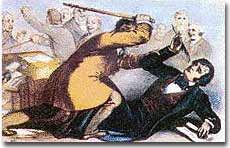
A famous Image showing the Caning of Charles Sumner
Charles Sumner, a leading republican and one of the most powerful antislavery voices in congress, was a large part of one of the events which took place in 19th century political events/debates. The caning of Charles Sumner, another violent act, occurred because of failure to realize the important issue. Charles Sumner delivered speeches, one being "The Crime Against Kansas". Included in his speech, he made insults against Senator Andrew Butler. As he said, "Not content with this poor menace, which we have been twice told was "measured," the Senator, in the unrestrained chivalry of his nature, has undertaken to apply opprobrious words to those who differ from him on this floor.  He calls them "sectional and fanatical"; and resistance to the Usurpation of Kansas he denounces as "an uncalculating fanaticism."   To be sure, these charges lack all grace of originality and all sentiment of truth; but the adventurous Senator does not hesitate." Clearly from this one remark, it is evident that Sumner did not like Butler, and therefore talked badly of him. Andrew Butler, senator of South Carolina, was angered by Sumner's words. Because of this, Butlers nephew Preston brooks, chose to beat Sumner with his cane. He was angry that Sumner had insulted Butler.  This event shows how even the most civilized men used violence. If people were just to simply sit down and deal with the present issue at hand, and not their own opinions, then there may have been possibility for compromise.
 

Abraham Lincoln and Stephan Douglas...The two men of the 7 debates
The Lincoln Douglas Debates , one of the most important events that was studied during this lesson, occurred in 1858. This was a series of seven debates which took place during the Illinois State Election. Through these debates, it was evident that much of the conflict revolved around slavery and rights. Abraham Lincoln and Stephan Douglas were complete opposites. During many of the speeches and throughout the campaign, both Lincoln and Douglas warned their supporters and voters of each other. These men were opposites solely because Douglas was for slavery and Lincoln was not. The main issue during the debates was in fact slavery, and the fact that both men did not necessarily agree with each other. Douglas supported "popular sovereignty". He believed that the majority of people in a state or territory could rule as they wished, but this included making slavery legal. Douglas tolerated slavery and wanted to make slavery legal because he believed in the absolute right for white citizens to choose the kind of society and government they want. On the other hand, Lincoln had a different point of view regarding Douglas' thoughts. Lincoln didn't agree that the majority should rule along with having the power to decide a minority's fate. In Lincoln's opinion, the majority should not have the power to decide a minority's (the blacks) rights to life, liberty, and happiness. Most of the debates revolved around the expansion of slavery to the territories. While Lincoln didn't believe in popular sovereignty, Douglas did.  This is where both men collided. In the end, Douglas ended up winning the election. Although there were many topics included in these debates, slavery was the one that caused the most contention. Slavery was the elephant in the room, because instead of sitting down and really discussing the obvious issue, different parties decided to simply disagree and cause more and more turmoil down the road. People weren't really thinking about slavery and the slaves involved, but their own opinions instead.
 
Alongside Bleeding Kansas and the Caning of Charles Sumner, John Brown's Raid also served as a violent act leading up to the civil war. On October 16th, 1859, Brown and several other whites and blacks chose to raid the federal arsenal in Harper's Ferry, Virginia. Brown and his followers hoped to
Many weapons were seized from Harpers Ferry.

This image shows the violent aspect of this event.
 
seize the weapons from the arsenal and five enslaved people so that they could rebel. They had a dream of an uprising of enslaved American's that would end slavery for good, punish slave holders, and lead the United States to moral renewal. However, resorting to violence only made things worse. John Brown believed that armed fighting was the right way to overthrow slavery in the United States.  Obviously, Browns motives did not follow through. A civil war still occurred and failing to attend to "the elephant in the room" caused more and more issues. After this, John Brown was hanged. Opposing reactions caused by Brown's raid only deepened the anger between the North and South.


Bleeding Kansas, The Caning of Charles Sumner, the Lincoln-Douglas Debates, and John Brown's raid are all huge indicator of the "elephant in the room" that everyone failed to attend to during the 19th century. If people had been more willing and open to exclusively discussing the more obvious issue, then there could have been possibility for compromise. But, instead, people chose to resort to violence. Violence does not solve anything. Although John Brown believed that his ways would be successful,  he was wrong. Any sort of violence does not solve issues and definitely does not help the debate over slavery. These events show that people must look at the big picture, and not the little issues that surround the big problem at hand.
 
 Citations:
 Charles Sumner/Preston Brooks: http://www.ushistory.org/us/images/00000499.jpg
Charles Sumner Quote: SOURCE:   The Works of Charles Sumner, vol. IV (Boston:   Lee and Shepard, 18701873), pages 125-249.
Harper's Ferry Photo:http://timelinewritingwiki.wikispaces.com/file/view/brown_harpers-ferry1.jpg/220567288/brown_harpers-ferry1.jpg


Monday, February 23, 2015

Losing Human Dignity

 
 After focusing on gender roles, my class soon switched over to slavery and the impact it had during the 19th century. As we learned about slavery, we reviewed and analyzed many documents as well as films and videos. These documents and movies allowed us to deeper our understanding of the boom of slavery during the 19th century. In this unit, we explored many essential questions, and branched off of the questions in order to answer the big overall question....How did slavery become economically entrenched in American Society by the early 19th century? As a result of the American and French Revolutions, thousands of black slaves escaped slavery by running away or revolting. However, even though people thought this would end slavery for good, they were wrong. Instead, the 19th century was a time when slavery became entrenched, and the lives of many people changed. Slavery rapidly expanded all around the world in places such as Brazil, Cuba, and the United States.

Cotton was an insignificant crop in the United States prior to 1800. By 1860, however, cotton production dominated large portions of the American South and by the 19th century slavery and cotton was booming. Shown in the maps and graphs below, it is evident that slavery had a direct relationship with the production of cotton. In 1792, a time when slavery was not booming, Eli Whitney created the Cotton Gin. This machine was the gateway into slavery and producing more and more cotton at a rapid speed. Between 1792, when Whitney invented the cotton gin, and 1794, the price of slaves doubled.  A reading known as "Cotton is King: Slavery is Entrenched in American Society" describes that, " By 1825, field hands, who had brought $500 apiece in 1794, were worth $1,500. As the price of slaves grew, so, too, did their numbers. During the first decade of the nineteenth century, the number of slaves in the United States rose by 33 percent; during the following decade, the slave population grew another 29 percent." Judging by these statistics, it is clear that the cotton gin had a large impact on not only cotton, but slaves as well.


This two maps show a direct relation between cotton and slavery. By 1830, slavery was rapidly increasing because of the Cotton Gin

Shown in this photo, it is clear that during 1790 Cotton was a sparse crop. Compared to later years, cotton was insignificant.


Throughout the Antebellum period, there were many advocates who spoke out against slavery, despite once being a slave. Frederick Douglas, a well-known intelligent intellectual, voiced his personal thoughts on slavery. Born into slavery, Douglas led a tough life. However, he was able to take his experiences and use them to his advantage. Through his many speeches and newspapers, Douglas declared his thoughts on how slavery is dehumanizing. In During Douglas' life, he defied one of the most dehumanizing laws, the fact that slaves could not read or write. A large portion of his life after the civil war was focused on voicing human rights and restoring human dignity for slaves. Included in one of his speeches, Douglas explores the idea that America is made up of hypocrites and frauds that celebrate their own achievements to cover up the fact that they do horrible things. The celebrate their own freedom, while ignoring the fact that they take away others. Through slavery, human dignity is destroyed and freedom is taken away. Slaves are bought like items at a store, which is a good indicator of how poorly slaves are treated and viewed.  When people are slaves because of their skin color, all respect is lost. When skin color is a prominent factor, then all people tend to look at those people differently. Empathy is lost and slaves are destroyed mentally and physically. Also, by not being able to read or write, slaves feel less and less like human beings.
 
Recently, we watched "Prince Among Slaves" and through this film It is evident just how badly slaved were treated. The main character, Abdul Rahman, is shown throughout his journey through slavery and the trouble he faces. It is clear that this film shows that slavery based on race tends to ignore many valuable human characteristics. Human characteristics such as respect of the human body/body limits  and basic human emotion and feeling was ignored. In "Prince Among Slaves", Rahman was bought into slavery after living a life of royalty and nobility. From sitting on a throne to working the fields, Rahman is a perfect example of how slavery is life altering and strips a person of all that they have earned and worked for. Slave owners forced slaves to work in the hot sun for long hours as shown in the film. Additionally, when Rahman arrived the Mr. Foster's, the slave owner, he was stripped of  his long hair. This long hair was a symbol of nobility, something which he now did not have. Mr. Foster totally ignored Rahman's emotional connection with his hair. He was thrown into slavery. Slaves are torn apart emotionally and feelings are totally disregarded. The antebellum period was a where slavery boomed and many advocates discussed slavery and the everyday lives of slaves.

Citations:
Maps: http://mappinghistory.uoregon.edu/english/US/US18-00.html
Frederick Douglas Excerpt: Frederick Douglas, "The Meaning of July Fourth for the Negro", a speech delivered in Rochester, New York, July 5, 1852


Sunday, February 1, 2015

Is it Really a "Man's Job"?

As we continued to study the social reform movements of the 19th century, it was only right to study the Woman's Reform movement that occurred in the mid-19th century. Gender equality between men and women has always been a leading issue from as far back as society can recall. Woman's rights is one of the most discussed topics and many people around the world have differing viewpoints about equality for all. Even though the Woman's reform was the last reform we discussed in class, it is certainly not the least important. In order to aide our understanding of the reform, my teacher provided many documents as well as photos for us to analyze. Most of the documents were primary source documents, which especially gave us a better understanding of how men viewed women during the 1800s. One of the documents in which we analyzed is known as The Rights of Woman: Laws and Practices. In this document, the way that women were viewed and the laws they had to follow are clear. The document covers all women's rights from divorce to voting. Additionally, woman were not allowed to speak in public, own property, attend school, go to school, take the children away from the mother in the event of a death , and it was even legal for men to beat their wives. Not only this, but women were expected to do al the cleaning, housework, cooking, and take care of the children with little help from their spouses.  These are only a few of the rights of woman, as there are many more that stand out to be irrational and immoral. To left, a photo of this document is shown.

Although there were many negative rights regarding women in the 1800s, there was also a movement that took place that aimed to support the rights of woman known as the Seneca Falls Convention. In response to this convention there were supportive and some negative opinions. It was through this movement that woman realized that they decided much more than they were getting. The Seneca Falls Convention took place in New York and was an abolitionist movement. A large amount of the reactions to the Seneca falls voiced how Woman's equality to men went against the bible and what was morally right. In an excerpt from The Mechanics Advocate, Female Department, there is a portion which directly discusses Adam and Eve and why woman should never be seen as equal to men. One being that Adam was born before eve, which some people believe justifies why women should not be considered equal. This article basically says that even the idea of women and men being equal is not only wrong but immoral as well.

In reaction to the Seneca Falls, although there were many unsupportive opinions regarding the women's fight for equality, there were also a select few of articles that supported the movement. On July 28th, 1848, The North Star, a newspaper article in response to the Seneca Falls Convention was written. However, instead of simply degrading the rights and privilege's of women, the article instead gave a different, more supportive input. Basically, this excerpt explains that every political right and right in general that man obtains, should be available to women as well. Both men and women are intelligent beings and both should be viewed that way. Women are entitled to everything that men are entitled to. All people should have equal opportunities, whether the opportunity is viewed as "manly". Unlike the article above , The North Star (to the left) supports women and their rights.

 
Because the 1800s was a few hundred years ago, it is important to evaluate society's view of women today. Is it different than  the 19th century? Is it the same? These are some of the toughest questions since there are thousands of different opinions regarding this topic. Personally, I believe that there is still gender inequality everywhere. Sadly, the world is not perfect and in many countries there are still recurring issues regarding the equality of men and women. There are still countless men who look down upon women for doing simple daily tasks that they believe are a "man's job". In some places, this topic is largely discussed, but for others its hardly mentioned. But just because it isn't talked about doesn't mean that it isn't a growing problem. Additionally, many women are scared to speak up for themselves in fear that they will be shamed or looked at differently. Everyday on the news, there are stories about inequality regarding ethnicity, skin color, and gender. Although sad, I believe that even if the world works hard to put an end to gender discrimination, there will always be people who don't agree. Below, I have provided a short video clip that depicts men and woman doing the same thing but being perceived differently.

https://www.youtube.com/watch?v=-K2kfgW7708

Citations:
1.The Rights of Women: Laws and Practices. Seneca Falls. 1848
2. Tanner, John. Female Department- Women Out of Their Latitude. The Mechanics Advocate. American Treasures of the Library of Congress
3.The Rights of Women. The North Star. American Treasures of the Library of Congress.


Monday, January 12, 2015

Nature and the Soul in Harmony: Transcendentalism

During the !9th Century, there were a select few of individuals who were solely interested in transcendentalism. Specifically, Ralph Waldo Emerson, a leader in the transcendentalist movement, wrote a book focused on the main principles of transcendentalism. Nature, Emerson's book, has been recognized as a major document in American Romanticism and Transcendentalism. Nature is one of the most well-known works of the 1800s and gives a deep insight of Emerson's beliefs and how nature effects one's soul. Because the chapter which I am going to focus on is very long, I chose to select just a couple paragraphs of the chapter to mainly focus on. The first chapter is called "Nature" which is one of the main tenets of transcendentalism. Below, I have provided an annotation of the few paragraphs and a photo of  Emerson's writing as well.

As Emerson was a leader of the transcendentalist movement, it is clear that he believed that the movement was a positive one and he wanted people to break away from society and be in touch with the natural world around them. Emerson explains that if an individual were to retire from all an any distractions, then he would be able to be more in touch with himself and would be more in harmony with nature. In these first few paragraphs of the chapter, Emerson explains his views on how nature is a beautiful thing and should never be taken for granted. After reading Emerson's essay, it is clear that he wants others to consider his transcendentalist thoughts and become more appreciative of the wild, rather than focusing only on material things. Seeing as this excerpt from is from Emerson's book, it is evident that these are his own thoughts and that he is simply explaining what he personally believes. Therefore, the excerpt is trustworthy in that sense, however transcendentalism is such a philosophical movement that everyone will and does have different opinions regarding Emerson's beliefs. In some cases, Emerson's book is controversial to some.  Nature was published in the fall of 1836 (anonymously) and gives an insight of the foundation of transcendentalism. The 19th century was the height of literary and romanticism in Europe and America. Transcendentalism, inspired by English and European Romantic authors, was a form of American Romanticism. Through reading this document, it is clear that transcendentalism was an interesting and different way to view the world. Instead of viewing nature in its literal sense, Emerson dives deeper into how nature, man, and god all connect. The paragraphs which are shown below give a good picture of transcendentalism and are a good introduction into Emerson's  thoughts and teachings. However, these few paragraphs don't necessarily give a complete picture of the event. Along with transcendentalism, there are many topics that Emerson touches upon. This includes, Nature, Commodity, Beauty, Language, and Discipline. So, although this small portion gives a lot of insight, there is much more to the transcendentalism movement. In the first chapter, Ralph Waldo Emerson says, "To go into solitude, a man needs to retire as much from his chamber as from society." In Emerson's opinion, an individuals must break away from society in order to really known themselves and have a relationship with nature on a more spiritual level. Emerson describes true solitude as going out into nature and leaving behind all  activities as well as society. This is merely just Emerson's opinion, and not everyone necessarily believes it. Also, Emerson explains, "Nature never wears a mean appearance". In his opinion, Nature is always beautiful and he goes on to say that society tends to take the beauty of the world/nature for granted. Every night the stars come out and many people don't even think twice about them. But, in reality , stars are one of the most beautiful parts of nature. As Emerson says, "If the stars should appear one night in a thousand years, how would men believe and adore; and preserve for many generations the remembrance of the city of God which has been shown!" If the stars were shown just once, people would be utterly amazed. In the introduction, Emerson also explains, "Undoubtedly we have no questions to ask which are unanswerable." He believes that everything has an answer, even if that answer will never be found. Emerson's writing and thoughts really gets the reader thinking and asking themselves questions that they wouldn't normally ask.  Emerson is trying to convince the reader that god, man, and nature all connect to each other. Nature and the soul are in harmony and nature is often taken for granted by society. Studying nature and the natural world around the, can bring people to find answers to their questions. Nature is a beautiful thing and once an individual can break away from all distractions, they will be able to appreciate it fully.
 
Source Citation:
 
Emerson, Ralph Waldo. “Ralph Waldo Emerson-Texts.” Emerson Central. http://www.emersoncentral.com/introduc.htm (accessed January 11, 2015).
 
Below are the paragraphs from which I based this annotation on: